The Redevelopment Line Hiding Inside Bergen-Lafayette's Price Gap
September 17, 2026
September 17, 2026
Ask a buyer why a Bergen-Lafayette condo costs less than one Downtown and most will say the same thing: it's earlier in its arc, give it time. That's true as far as it goes. It also skips a mechanism that has nothing to do with momentum and everything to do with a boundary line the city drew years ago, one that decides whether the building you're bidding on can carry a tax structure that doesn't exist two blocks away.
That mechanism is the payment in lieu of taxes, or PILOT, and it is not spread evenly across the neighborhood. It applies to a narrower slice of Bergen-Lafayette than most listing sheets let on, and figuring out which side of the line a given address sits on is homework that pays off during attorney review, not before you make an offer.
Start with what the numbers say, because they're real and they matter. Hudson County MLS data covering 61 closings in Bergen-Lafayette from January through May 2026 puts the overall median sold price at $670,000, at a median of $443 per square foot across the market. Within that, condos closed at a median of $555,000, two-family homes at $720,000, and single-family homes at $575,000. Homes moved quickly for the category, averaging 47 days on market, and sellers took home 97.7 percent of asking price on average.
Set that against Jersey City's citywide condo market. In June 2026, the city's median condo sale price ran $724,000, up 5.7 percent year over year, with units selling in 35 days at 99.5 percent of list. Entry-level condos in Journal Square, the Heights, and Bergen-Lafayette were pricing $350,000 to $600,000 that same month, while mid-market Downtown and Powerhouse Arts District units traded $600,000 to $900,000, and premium Downtown high-rises with river views ran $900,000 to $1.5 million.
That's a real gap. The easy explanation is that Bergen-Lafayette simply hasn't caught up yet. The more useful explanation is that part of the gap is structural, and it won't close just because more storefronts open on Communipaw Avenue.
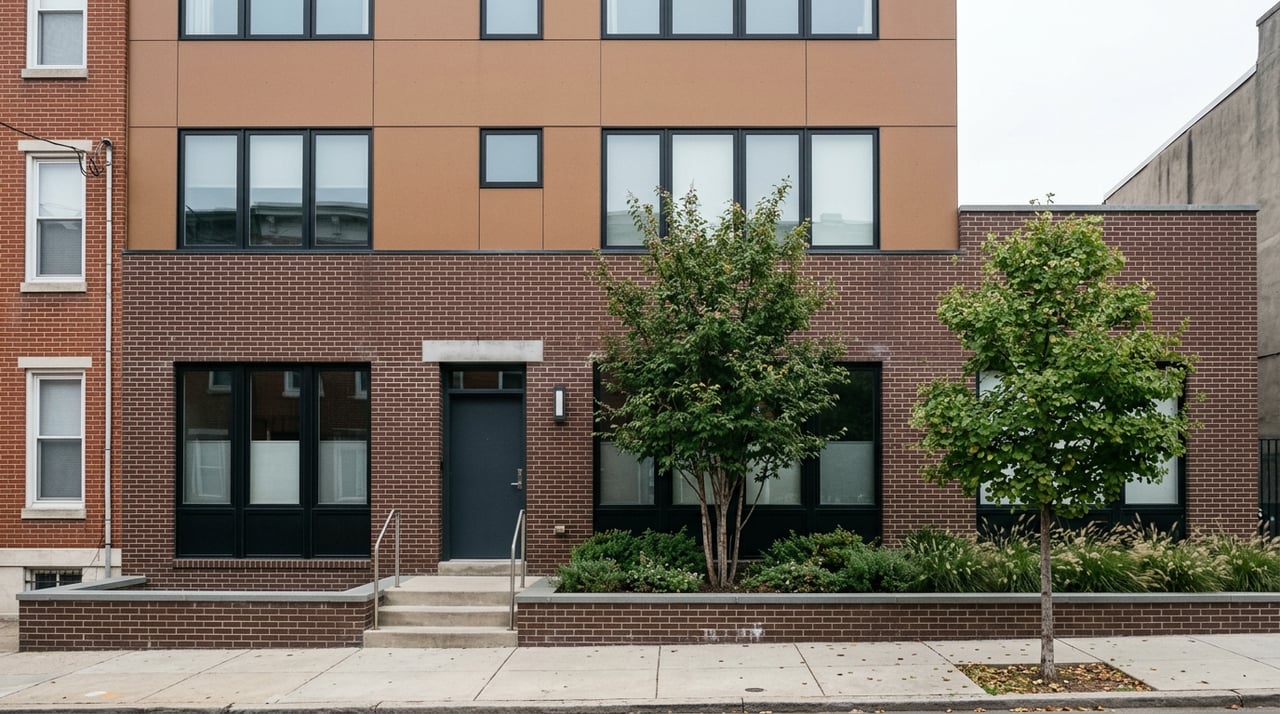
Some of the gap is architecture, plainly. New construction in Bergen-Lafayette over the last several years has mostly taken the shape of small condo buildings, four to twenty units, with parking and roof decks, not high-rises. There are no towers here and no doorman buildings, which caps what any single unit can fetch regardless of finish level. The historic core along Pine and Lafayette Streets near Lafayette Park is rowhouse and brick stock from the 1870s through 1900s, some restored, some still waiting. Converted factories and warehouses sit along the old canal route, and buildings like the Foundry Lofts have turned that industrial stock into loft-style condos with the ceiling height and light you don't get in a standard postwar layout. Berry Lane Park, 17 acres built on a former rail yard, opened in 2016 on the neighborhood's eastern edge and changed the math for buyers who want green space without a waterfront price tag.
None of that is a tax story. It's a simple fact about building stock: a neighborhood without towers prices differently than one with them.
Here's the piece that doesn't show up on a walk-through. New Jersey redevelopment law lets a municipality offer long-term tax deals to developers, but only under specific conditions: the property has to sit inside a designated redevelopment area, the developer has to be structured as an Urban Renewal LLC, and an independent financial analysis has to show the project wouldn't happen without the deal. Miss any one of those three and a PILOT isn't on the table.
Jersey City's own ordinance, authorized under Section 304 of the municipal code, names a short list of places where this applies. A detailed breakdown from Better Blocks NJ, a New Jersey housing policy outlet, notes that most of the city's residential neighborhoods sit outside redevelopment areas entirely, except around Downtown, Journal Square, and Lafayette. That last name isn't shorthand for the whole neighborhood. It refers to a specific, legally drawn redevelopment plan area that overlaps only part of Bergen-Lafayette.
A PILOT and a conventional tax bill are not the same thing wearing a different name.
A PILOT payment is typically calculated as a percentage of a building's income rather than a tax on your unit's assessed value, and it can run 10 to 30 years once the project is complete. A standard five-year tax exemption works differently. Jersey City issues that type on the improvements only, meaning the new construction is phased into full taxation over five years while the land underneath keeps paying conventional rates the whole time. A building running a 20-year PILOT and a building three blocks away on a five-year exemption, both finished the same year, both marketed as new construction, are on entirely different tax clocks. The address decides which clock applies, not the floor plan.
This is where the friction actually shows up, and it rarely surfaces until attorney review. A tax line on a new-construction listing sheet is not always a projected conventional bill. It may be a PILOT service charge, tied to building revenue rather than your unit's assessed value, with its own escalation schedule and its own reversion date, the year the building goes back to paying full conventional property tax. Buying into year three of a 20-year PILOT is a different math problem than buying into year eighteen, even when the sale price and the monthly number look identical on paper today.
The $7,041 median annual property tax MLS data shows for Bergen-Lafayette over that January through May 2026 window is useful context, but it's an average across a neighborhood where some units sit inside the Lafayette redevelopment boundary and some don't. Treat it as a starting point for a conversation with your attorney and the seller, not a number you carry from one listing to the next.
| Mechanism | Duration | What's taxed | What to ask |
|---|---|---|---|
| Conventional assessment | Ongoing | Full assessed value of land and improvements | Has the unit been reassessed since renovation or new construction? |
| Five-year tax exemption | Up to 5 years | Only improvements are phased in; land taxed conventionally throughout | How many years remain, and what's the projected bill after year five? |
| PILOT | 10 to 30 years | A negotiated service charge, typically a share of building revenue, in place of conventional tax | What year of the term is this, and what happens at reversion? |
Before comparing two listings on price per square foot alone, ask which of these three categories actually applies to each one. A few questions worth putting to a listing agent or seller's attorney directly:
None of this shows up in a walk score or a square footage listing. It shows up in the documents your attorney requests, and it's worth asking for before you're two weeks from closing.
None of this is a reason to write off Bergen-Lafayette. Three light rail stops, at Liberty State Park, Garfield Avenue, and Jersey Avenue, reach Exchange Place in roughly ten minutes and Hoboken in about twenty, with the PATH and ferries waiting there. Grove Street PATH itself is a fifteen to twenty-five minute walk from the neighborhood's northern blocks. Lafayette Park anchors the historic core with a playground and a pool.
The price gap with Downtown is real, and some of it will likely narrow as more of the neighborhood's small-scale new construction gets built out. But treating the whole gap as a timing story misses the part a PILOT boundary explains on its own, and that part won't close just because the neighborhood gets more popular. It closes, or doesn't, based on where the redevelopment lines were drawn years ago and what happens when each building's term runs out.
Is all of Bergen-Lafayette inside a PILOT-eligible redevelopment area? No. Only the section within the specific Lafayette redevelopment plan boundary qualifies under the conditions New Jersey law sets for PILOTs. Much of the surrounding neighborhood sits outside any designated redevelopment area.
Does a PILOT mean I pay no property tax at all? No. A PILOT replaces the conventional property tax with a negotiated service charge, usually tied to the building's revenue, that still goes to the municipality and county. It's a different bill, not the absence of one.
How do I find out if a specific listing is under a PILOT before I make an offer? Ask the listing agent for the building's tax history and abatement status directly, and have your attorney confirm it against the property record before you're under contract, not after.
If you're comparing a Bergen-Lafayette listing against something Downtown, or trying to make sense of a tax line that looks different from the one on the building next door, Amy DeAngelo Real Estate can walk through a specific address's redevelopment and abatement history before you write an offer. If you're the one selling into this market, start with a free home valuation to see where your property actually sits in the current pricing picture.
Stay up to date on the latest real estate trends.


Experience a real estate partnership built on trust, expertise, and genuine care. Amy brings a lifelong understanding of what “home” truly means to every client and every decision.